Siding that
survives here
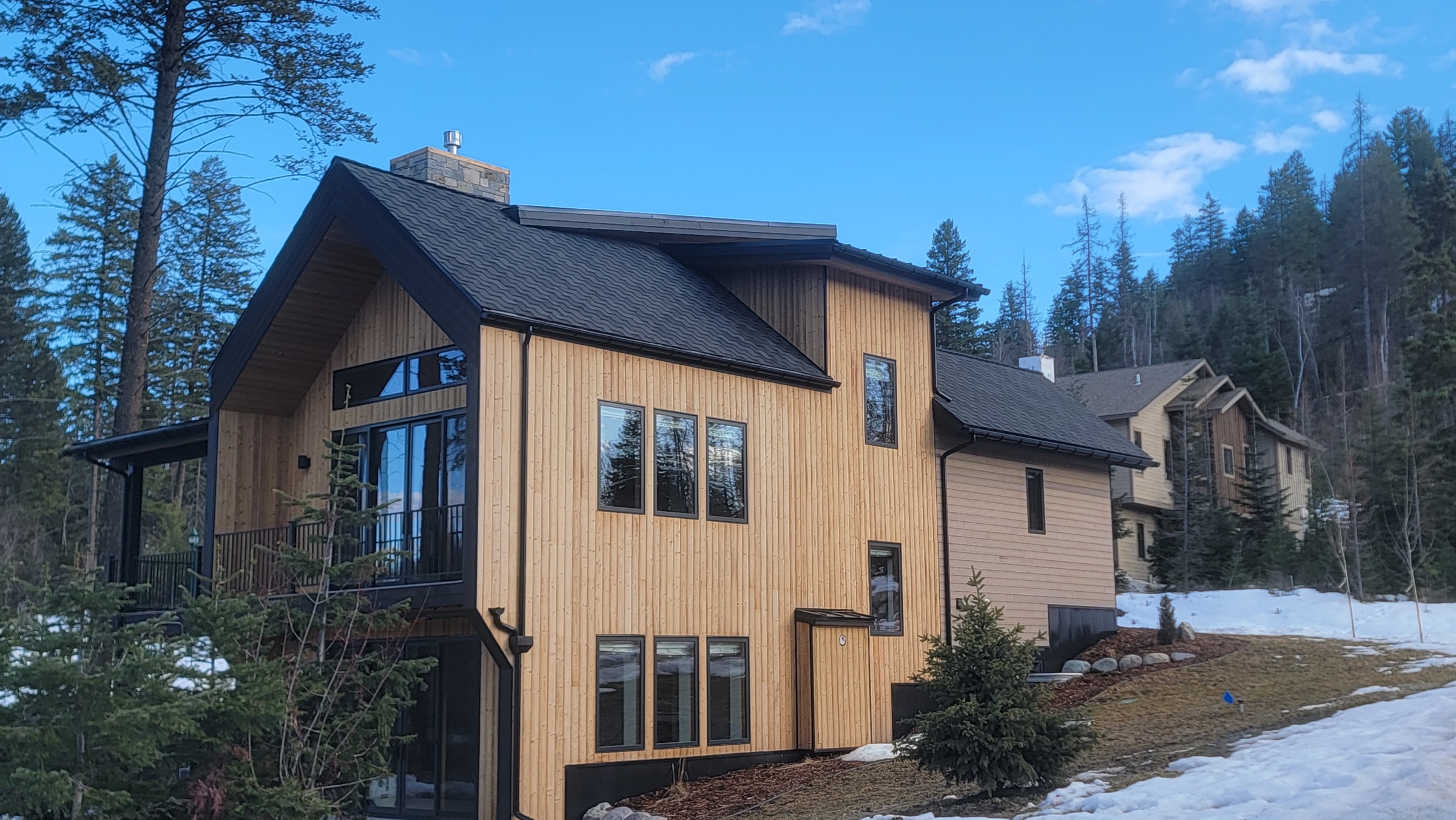
Freeze-thaw all winter, UV at elevation, and hail that arrives without warning. Siding in the Flathead Valley fails for reasons siding in Phoenix never does — and almost always because of water, not the panels. We install LP SmartSide, James Hardie, metal and aluminum.
Licensed & insured
Montana contractor, fully covered
Written warranty
Workmanship guaranteed in writing
Five-star reviews
From neighbours across the valley
Clean job sites
Magnet-swept before we leave
Siding fails from behind
When siding goes wrong, people assume they picked the wrong material. Usually they didn't. What failed is the water management behind it — the housewrap, the flashing at windows and doors, the kick-out where a roof meets a wall.
Siding is a rain screen, not a seal. Water gets behind it on every house, every storm. The job of the assembly is to drain that water back out. When it can't, the sheathing rots quietly for years before anything shows on the outside.
The four details that actually matter
Ask any contractor about these before you ask about material or colour. If they get vague, that's your answer.
- Weather-resistive barrier — installed shingle-style, upper courses lapping over lower, so gravity works with it rather than against it
- Window and door flashing — pan flashing at sills, proper head flashing above. This is where most leaks start
- Kick-out flashing — where a roof edge meets a wall. Miss it and roof runoff pours straight into the wall cavity. It is the single most commonly skipped detail in the trade
- A drainage gap — a rainscreen or drainable housewrap so water and vapour have somewhere to go instead of sitting against your sheathing
What our winters do to siding
Freeze-thaw. Water that gets into a material and then freezes expands. Do that a few hundred times a winter and anything porous starts to break down — which is why moisture-absorbing materials struggle here even when they're rated for cold.
UV at elevation. There's less atmosphere filtering sunlight up here. Colours fade faster than the manufacturer's flatland testing suggests, and dark colours on south and west walls take the worst of it.
Hail. Impact resistance matters as much on your walls as on your roof, and wall damage from hail is routinely missed on insurance inspections because the adjuster is looking up.
Snow load at grade. Siding that sits too close to where snow piles against the house wicks moisture all winter. Proper clearance at the bottom course is not optional.
Repair or replace
Replacement isn't always the answer, and we'll say so. Repair usually makes sense when the damage is localised — one elevation after a storm, a section below a failed gutter — and the rest of the assembly is sound.
Full replacement makes sense when we open a wall and find the housewrap is failed or absent, when there's rot in the sheathing, when the same problem keeps recurring in different spots, or when the material itself has reached the end of its life across the whole house.
The inspection tells us which. Sometimes the honest answer is a repair and a gutter fix.
Do the roof and siding together
If both are due within a few years of each other, doing them in one project usually saves real money. One mobilisation, one set of scaffolding, one crew, one dumpster.
More importantly, the roof-to-wall transitions get done as a single detail by the same people, instead of one trade flashing into another trade's work and each assuming the other handled it. That junction is where a surprising number of leaks live.
Worth asking about at the inspection even if you only called about one of them.
What we install
Four lines, chosen because they hold up here. Which one is right depends on your exposure, your budget, and how long you're staying.
| Strengths | Trade-off | |
|---|---|---|
| LP SmartSide | Treated engineered wood. Good impact resistance, lighter and faster to hang than fibre cement, takes paint beautifully, looks like real wood | Wood-based, so cut edges must be sealed properly on install — skip that and you've built in a failure point |
| James Hardie | Fibre cement. Non-combustible, holds colour, extremely durable, and Hardie makes cold-climate versions engineered for freeze-thaw | Heavy, slower to install, and costs more. Cutting needs proper dust control |
| Metal | Steel. Non-combustible, the longest life of the four, and the natural match for a standing seam roof | Can dent from hail, fewer profiles, needs a specialist install |
| Aluminum | Non-combustible and will never rust, which is why it's the right call for soffit and fascia | Softer than steel, so it dents more easily on impact-exposed walls |
One question worth asking us: Hardie sells climate-specific product lines, and the cold-climate version is the one you want in the Flathead. Ask which you're being quoted — a contractor who doesn't know the answer hasn't thought about your winters.
Wildfire, and why three of those four are non-combustible
This gets overlooked on siding decisions and shouldn't, not in Northwest Montana. James Hardie, metal and aluminum are all non-combustible. LP SmartSide is treated engineered wood, so it isn't.
That doesn't rule LP out — it's an excellent product and it's what a lot of these homes should have. But if you're on a wooded lot, backing onto forest service land, or in an area where your insurer has been asking questions about wildfire exposure, the material choice is worth weighing differently. Sometimes it affects your premium.
We'll raise it at the inspection if your lot makes it relevant.
What a re-side includes
- Tear-off and disposal of the existing siding
- Sheathing inspection, with any rot or water damage replaced
- New weather-resistive barrier, correctly lapped
- New flashing at every window, door, and roof-to-wall junction
- Kick-out flashing where roof edges meet walls
- Siding, trim, corners, and soffit as specified
- Caulking and sealing at penetrations
- Magnet sweep and full site clean-up
- A written workmanship warranty alongside the manufacturer's material warranty
Storm and hail on siding
If this is insurance work rather than age, start on our storm damage page. Wall damage gets overlooked on claims more often than roof damage, and documenting it properly at inspection is what gets it covered.
Where we work
Whitefish, Kalispell, Columbia Falls, Bigfork, Lakeside, Marion, Kila, Polson, Eureka, Rexford, and out to Missoula.
Have us look at your walls
Free inspection, photographs of whatever we find, and a fixed written price. If it's a repair rather than a re-side, we'll tell you that.
- Phone or text
- (406) 300-4215
- info@grizzlyridgemt.com
- Office
- 346 Central Ave, Whitefish, MT
- Response
- Within one business day